View Press Release
FOR IMMEDIATE RELEASE

City of Duluth - Police Department
Mike Ceynowa, Chief of Police
2030 North Arlington Avenue • Duluth, Minnesota 55811 • www.duluthmn.gov
2030 North Arlington Avenue • Duluth, Minnesota 55811 • www.duluthmn.gov
For more information contact:
Public Information Officer, Mattie Hjelseth at (218) 730-5434 or mhjelseth@duluthmn.gov
Public Information Officer, Mattie Hjelseth at (218) 730-5434 or mhjelseth@duluthmn.gov
DATE: 4/16/2013
SUBJECT: Enhanced Distracted Driving Enforcement and Education
BY: DPD Public Information Officer Jim Hansen (218) 390-2232
NATURE OF INCIDENT: Enhanced Distracted Driving Enforcement & Education
CASE NO.:
INCIDENT DATE: 4/18/2013
INCIDENT TIME:
INCIDENT LOCATION: Duluth and Surrounding Area
SUBJECT: Enhanced Distracted Driving Enforcement and Education
BY: DPD Public Information Officer Jim Hansen (218) 390-2232
NATURE OF INCIDENT: Enhanced Distracted Driving Enforcement & Education
CASE NO.:
INCIDENT DATE: 4/18/2013
INCIDENT TIME:
INCIDENT LOCATION: Duluth and Surrounding Area
The Duluth Police Department, St. Louis County Sheriff’s Office, UMD Police Department, Minnesota State Patrol, Hermantown Police Department, Proctor Police Department and Floowdwood Police Department will have enhanced Distracted Driving enforcement and education during April.
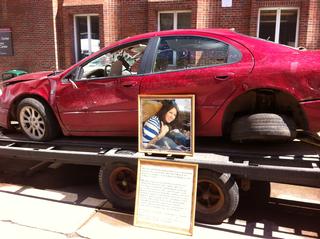
As part of the campaign to raise awareness of the perils of Distracted Driving, parents of a Minnesota teen killed in a 2012 crash involving distracted driving have allowed law enforcement agencies across the state to display the vehicle she was killed in and made her story available in an effort to prevent others from serious injury or death. Local law enforcement and area schools have teamed up together to facilitate displaying the vehicle at the following locations next week:
Thursday, April 18th- 9:00AM-2:30PM, Proctor High School
Monday, April 22nd- 11:00AM - 1:00PM, Denfeld High School
Tuesday, April 23rd- 8:30AM – 1:30PM, East High School
Thursday, April 25th- throughout the day, Floodwood School
Friday, April 26th- 9:30AM-10:30AM, Marshall High School
The following is a brief factual reconstruction of the accident:
“On March 23rd, 2012 at approximately 9:16PM a 1999 Chrysler 300 was travelling in excess of the posted speed limit on County Highway 61 in Pine County while being driven by a 16 year old female with an 18 year old female occupying the right front passenger seat. Both of the females were actively texting when the roadway began a curve to the left with the Chrysler continuing straight, thereby travelling off of roadway. The 16 year old driver reacted by swerving in an attempt to correct back onto the roadway however it was too late with the Chrysler striking a driveway approach and rolling over multiple times. The 16 year old driver was ejected from the Chrysler due to no seatbelt use and she died at the scene. The 18 year old passenger was belted, remained in the Chrysler, and received non-life threatening injuries.
This crash involved a newly licensed driver, excessive speed, driver distraction via texting, and lack of seatbelt use by the driver. This crash not only impacted the 2 involved families but the entire community to include those that responded to the scene of this avoidable crash. The family of the victim donated this vehicle and the story of this tragedy so that others can learn from this crash to avoid having to go through it with their families.”
Distracted Driving
Take Action to Stop the Distraction
Distracted or inattentive driving is when a driver engages in any activity that might distract them from the primary task of driving — and increases their risk of crashing.
Each year in Minnesota, distracted or inattentive driving is a factor in one in four crashes, resulting in at least 70 deaths and 350 serious injuries. OTS estimates these numbers are vastly underreported due to law enforcement’s challenge in determining distraction as a crash factor.
While many motorists may perceive driving as a routine activity, attentive driving is critical as the traffic environment changes constantly and drivers must be prepared to react.
Tips to Avoid Distracted Driving
Drivers face many distractions behind the wheel. Share these tips with family and friends to take action to stop the distraction:
- Cell phones — turn off cell phones, or place them out of reach to avoid the urge to dial or answer. If a passenger is present, ask them to handle calls/texts.
- Music and other controls — pre-program favorite radio stations for easy access and arrange music (mp3 player/CDs/tapes) in an easy-to-access spot. Adjust mirrors and heat/AC before traveling, or ask a passenger to assist.
- Navigation — designate a passenger to serve as a co-pilot to help with directions. If driving alone, map out destinations in advance, and pull over to study a map.
- Eating and drinking — try to avoid food/beverage, at least messy foods, and be sure food and drinks are secured.
- Children — teach children the importance of good behavior in a vehicle; do not underestimate how distracting it can be to tend to children while driving.
- Passengers — speak up to stop drivers from distracted driving behavior.
- When making/receiving a call, ask if the person is driving. If so, ask them to call back at a safer time.
Distracted Driving Laws
Texting and Web Access
It is illegal for drivers of all ages to compose, read, or send electronic messages or access the Internet on a wireless device when the vehicle is in motion or part of traffic. This includes being stopped in traffic or at a light.
The law does not apply to devices that are permanently affixed to the vehicle or global positioning or navigation systems.
Cell Phone Use and Texting
- It is illegal for drivers under age 18 to use a cell phone, whether hand-held or hands-free — except to call 911 in an emergency.
- Cell phone use is totally banned for school bus drivers.
Reckless or Careless Driving
- Distracted drivers can be ticketed for reckless or careless driving when their actions demonstrate a disregard for the safety or rights of others.
The efforts conducted by Area Law Enforcement are components of the state’s Toward Zero Deaths (TZD) traffic safety program. A primary vision of the TZD program is to create a safe driving culture in Minnesota in which motorists support a goal of zero road fatalities by practicing and promoting safe and smart driving behavior. TZD focuses on the application of four strategic areas to reduce crashes — education, enforcement, engineering and emergency trauma response.